
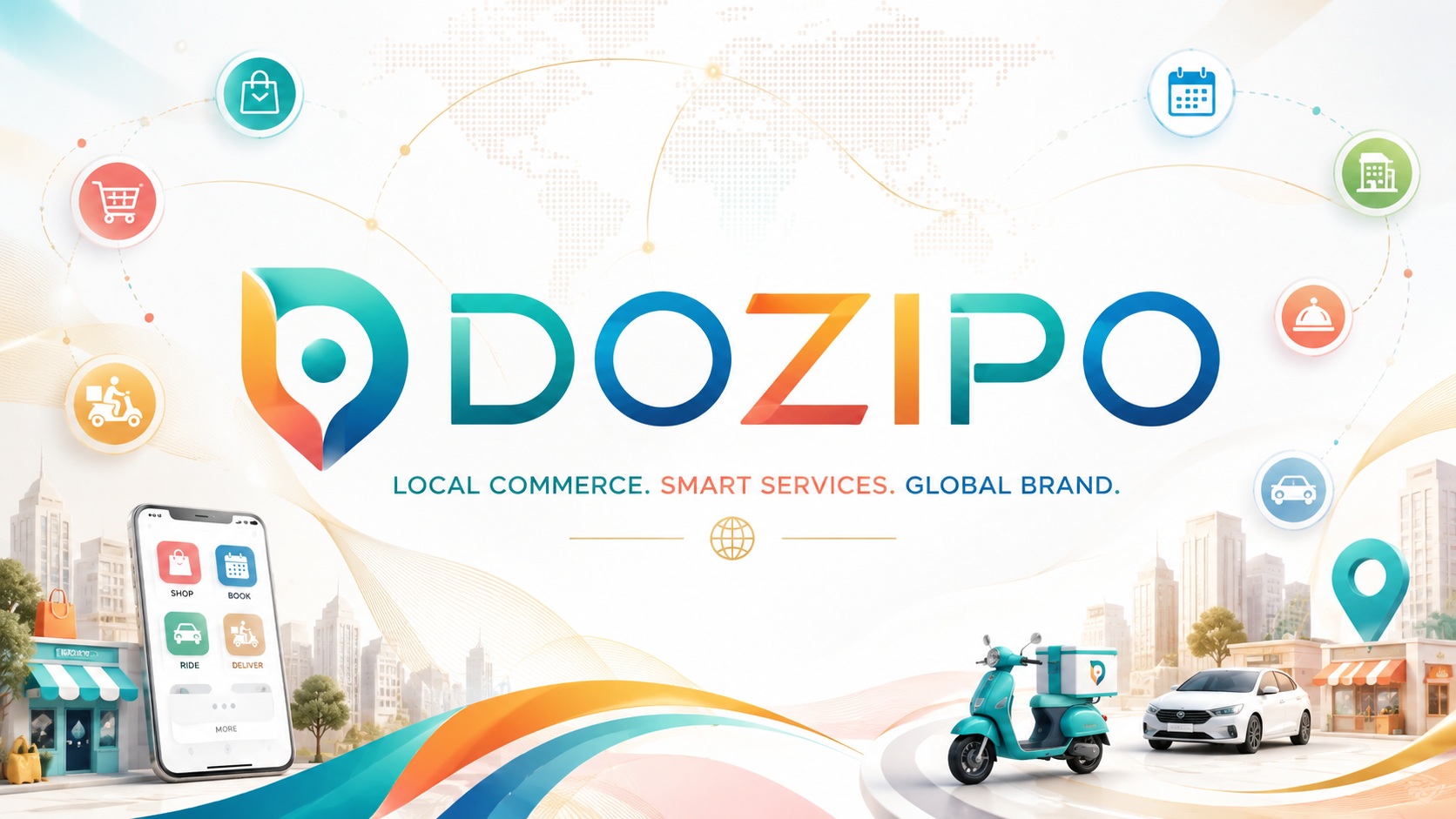
From Delivery App to Local Commerce Platform: Why Multi-Service Brands Need Room to Expand
The consumer platform economy is becoming broader than individual categories. Delivery can expand into groceries. Mobility can connect with payments. Booking can merge with local discovery. A marketplace can become an everyday services layer. That creates a naming problem for founders: how do you choose an identity before you know which services will eventually become the company's largest business? DOZIPO.com offers an instructive case study in building a compact consumer brand around flexibility rather than a single transaction.
The modern consumer platform may start with one service but succeed through many
A founder can launch with food delivery, bookings, local transport, retail discovery or another narrowly defined use case. The strategic problem begins when customer behavior creates opportunities outside that original category.
A strong multi-service identity should therefore describe the company less narrowly than its first product. DOZIPO is interesting because it behaves like a consumer brand before it behaves like a category description: short, rhythmic, visually compact and sufficiently abstract to move with the business.
The Market Shift: Digital Commerce Is Expanding Beyond the Checkout
Digital commerce used to be understood primarily as online retail. The emerging consumer-platform model is wider. The transaction can involve a restaurant, supermarket, pharmacy, local merchant, driver, service provider, reservation, package, experience or financial service.
In the United States, online retail continues to expand, while major consumer platforms are simultaneously pushing beyond their original categories. The more strategically important signal is therefore not simply that commerce is becoming digital. It is that different types of digital transactions are increasingly being assembled under fewer consumer relationships.
The valuable customer relationship is no longer necessarily “the person who orders food.” It may become “the person who opens one platform whenever something needs to happen locally.”
The Market Problem: Category Success Creates Naming Risk
Many startups sensibly begin with one sharply defined problem. Product-market fit requires focus. Brand architecture, however, has a different time horizon.
A company called around one literal transaction may gain immediate clarity but accumulate friction later. If a delivery platform adds local retail, the original name can become narrow. If a mobility app adds payments and reservations, a transport-specific identity can feel incomplete. If a booking product evolves into an urban-services marketplace, the first descriptive category may no longer represent the company.
Category Lock-In
The corporate identity remains attached to the first service even after customer demand moves elsewhere.
Expansion Friction
Every new product requires additional explanation because the parent name implies a narrower company.
Consumer Confusion
Users may mentally classify the company as one type of service even when the platform has evolved.
Rebranding Debt
The larger the installed user base, merchant network and partner ecosystem, the more expensive identity migration becomes.
This is why the broader DOMEIXA analysis of domain-first versus brand-first startup strategy becomes particularly relevant for consumer platforms. The initial service can be narrow. The permanent identity does not necessarily need to be.
The Naming Vacuum: Why “Delivery”, “Booking” or “Market” Can Be Too Small
Descriptive naming is useful when the company intends to remain inside one durable category. It becomes less attractive when the strategic value of the business may eventually come from cross-category behavior.
Imagine a founder choosing a name around grocery delivery. The product succeeds. Customers then use the same application for restaurant orders, pharmacy purchases, package delivery and local retail. The original descriptive name has not become wrong—but it has become incomplete.
A multi-service brand therefore benefits from what might be called semantic headroom: enough identity to become memorable, but enough openness to support products the founder has not yet launched.
The product should explain today's transaction. The parent brand should be able to survive tomorrow's business model.
The Identity Thesis: DOZIPO as a Consumer Platform Name
DOZIPO does not attempt to describe a delivery category, mobility category or booking category. That is precisely what makes it strategically interesting for a multi-service company.
The name is compact, contains six letters and naturally separates into three short spoken beats. Its consonant-vowel rhythm gives it a more conversational quality than a corporate acronym, while the unusual central spelling makes the complete word visually proprietary.
The result is an identity that can plausibly sit on a mobile application, payment screen, courier vehicle, merchant terminal, booking interface or membership product without forcing the brand into one of those categories.
DOZIPO is strongest as the name of the relationship, not the name of the transaction.
A transaction can be delivery, booking, shopping, transport or another service. The parent identity can remain DOZIPO while the product architecture explains what happens underneath it.
The Phonetic Test: Consumer Brands Have to Work Out Loud
Consumer technology names are spoken in environments enterprise brands often avoid: recommendations between friends, customer-service conversations, radio and video advertising, app-store searches, creator content and voice interfaces.
DOZIPO has an advantage here because the pronunciation can be naturally resolved as three short syllables: do-zi-po. The alternating sound pattern avoids difficult consonant clusters and creates a repeatable cadence.
That does not guarantee memorability—only market exposure can create that—but it gives a future brand a useful phonetic foundation. The same spelling can be used consistently across spoken and written channels without needing a shortened consumer nickname.
Short spoken rhythm + uncomplicated spelling + proprietary sound gives DOZIPO stronger potential for consumer recall than a long descriptive service name.
The App Icon Test: Can the Identity Live on a Phone?
Consumer platforms are experienced repeatedly through small interfaces. That makes mobile identity unusually important. Long names disappear into abbreviations, while highly descriptive combinations can become visually indistinguishable from competitors.
DOZIPO can remain visible as a complete wordmark in many digital environments while also providing several possibilities for a compact symbol—D, DZ or an abstract icon derived from the brand system.
The strategic point is not the exact logo. It is that the name does not require a descriptive subtitle to remain recognizable once the brand has accumulated market meaning.
Brand Character Matrix
| Dimension | DOZIPO Character | Strategic Implication |
|---|---|---|
| Enterprise ↔ Consumer | Consumer-led | Natural fit for mobile applications, marketplaces and recurring everyday services. |
| Descriptive ↔ Abstract | Abstract | The company can define the brand instead of inheriting a narrow category definition. |
| Formal ↔ Friendly | Friendly-modern | The phonetic rhythm supports frequent consumer use without becoming childish. |
| Single Service ↔ Ecosystem | Ecosystem-oriented | The name can remain above several services and product categories. |
| Local ↔ Global | Structurally global | No geographic word or national reference restricts international expansion. |
| Technical ↔ Experiential | Experiential | The identity can represent the consumer experience rather than the underlying logistics technology. |
Market Fit: Where Could DOZIPO Be Most Credible?
| Potential Category | Fit | Brand Logic |
|---|---|---|
| Local Commerce Platform | Very High | Broad enough to connect merchants, consumers, services and transactions without category lock-in. |
| Multi-Service Consumer App | Very High | The abstract identity can sit above several daily-use functions. |
| Delivery & Last-Mile Platform | High | Short and action-oriented enough for high-frequency consumer use while preserving expansion room. |
| Mobility & Urban Services | High | The brand is not dependent on a particular vehicle, transport mode or city. |
| Booking & Experiences | High | Friendly phonetics work for consumer discovery and transactional interfaces. |
| Local Marketplace | Very High | The name can represent the marketplace itself rather than one merchant category. |
| Consumer Membership Ecosystem | High | A parent identity can hold loyalty, benefits, payments and multiple service verticals. |
| Deep Enterprise Infrastructure | Medium–Low | The approachable consumer character is less naturally institutional than names designed for enterprise architecture. |
The Deployment Test: What Happens When One Service Becomes Six?
The strongest test of a multi-service name is whether products can be added beneath it without rebuilding the parent brand. One possible architecture illustrates the principle:
DOZIPO Go
Mobility, local transport or rapid point-to-point services.
DOZIPO Market
Local retail, grocery, merchants and neighborhood commerce.
DOZIPO Book
Reservations, appointments, experiences and local services.
DOZIPO Pay
Payments, credits, loyalty and transaction infrastructure.
DOZIPO Now
High-priority on-demand services and rapid fulfillment.
DOZIPO Plus
Membership, bundled benefits and recurring consumer engagement.
These are naming simulations, not existing products. Their purpose is to test whether DOZIPO can behave as a parent brand. In this architecture, each extension explains a use case while the central name remains stable.
The Network Effect Test: Consumers, Merchants and Service Providers
A local-commerce platform is not merely a consumer application. It can eventually become a network connecting multiple participant groups: consumers, restaurants, stores, independent professionals, drivers, couriers, venues and commercial partners.
That changes the naming requirement. A brand that sounds appropriate only for the consumer side may become awkward in merchant software. A deeply technical logistics name may work for operators but lack warmth in a consumer app.
DOZIPO occupies a useful middle territory. The parent brand can remain approachable while business-facing extensions can become more functional: DOZIPO Business, DOZIPO Partners, DOZIPO Merchant or DOZIPO Connect.
The consumer sees one easy brand. Merchants and partners can see an entire operating ecosystem underneath it.
The Founder Perspective: Focus the Product, Not Necessarily the Name
Founders are often told to start narrow, and that advice remains strategically sound. A startup cannot launch six businesses at once simply because its name permits six businesses.
The distinction is between operational focus and identity optionality. The company may launch with one service, dominate one workflow and learn one market. The name merely avoids forcing management to undertake a rebrand when expansion becomes rational.
That makes DOZIPO particularly relevant to businesses where adjacent categories can emerge naturally from the same customer relationship, merchant network or logistics infrastructure.
The Investor Perspective: Expansion Optionality Without a Conglomerate Name
From an investment perspective, a broad brand is not valuable because it promises expansion. Expansion itself can destroy value when it lacks strategic logic. The naming advantage is more modest: the identity does not become the obstacle if adjacent growth does make sense.
A consumer platform that adds new verticals can retain one recognizable corporate entity, one domain, one branded-search footprint and one parent customer relationship while measuring each additional business on its own merits.
DOMEIXA examines the broader distinction between operational utility and digital-asset ownership in Premium .COM Domains as Balance Sheet Assets.
The .COM Layer: One Global Address for a Multi-Service Brand
A short `.COM` does not create demand, rankings or trust automatically. Its more defensible role is continuity. A company can use one primary digital identity while products, cities, categories and business units expand beneath it.
For a consumer ecosystem, that continuity can matter across app-store references, merchant onboarding, QR codes, advertising, customer support, corporate email, investor communication and international launch campaigns.
The broader question of scarcity versus actual usability is examined in DOMEIXA's analysis of short .COM identities.
International Scalability: Local Services, Global Brand Architecture
Local commerce creates an interesting paradox: the service must understand each individual city, but the corporate identity may need to operate across many countries.
| Market | Possible Strategic Context | DOZIPO Brand Consideration |
|---|---|---|
| United States | Local commerce, delivery, retail, mobility and consumer marketplaces | A short invented name can expand without being tied to one retail or delivery category. |
| Canada | North American consumer platforms and urban services | The name transfers easily from a U.S.-oriented launch without requiring a new linguistic identity. |
| United Kingdom | Delivery, fintech, booking and local-service platforms | Compact consumer branding is compatible with several digital-service verticals. |
| Netherlands | International commerce, logistics and digital consumer businesses | The abstract construction avoids dependence on an English category keyword. |
| Estonia | Digital-first companies designed for cross-border operation | A brandable `.COM` can function independently of a small domestic market. |
| Singapore | Multi-service digital ecosystems and Asia-Pacific expansion | Short phonetic structure is suited to a company crossing several service categories. |
| Germany & Switzerland | Commerce, mobility, logistics and high-trust digital services | The brand can remain consumer-friendly while functional sub-brands communicate individual products. |
The objective is not geographic keyword targeting. The more important property is that the same identity can enter different markets while each local operation adapts its services, partnerships and messaging.
The Counter-Thesis: Where DOZIPO Is Less Suitable
Highly institutional enterprise software: DOZIPO's approachable sound is less naturally suited to a formal architecture framework or specialized industrial system.
Ultra-luxury heritage positioning: the energetic digital character would require substantial brand work to fit traditional prestige categories.
Pure descriptive SEO strategy: founders seeking an exact-match category name would need a different naming philosophy.
Trademark clearance remains mandatory: a strong domain structure does not establish legal trademark availability in any jurisdiction or commercial class.
These limitations are valuable because they clarify the identity. DOZIPO is not universally neutral. Its strongest environment is modern, transactional, consumer-facing and digitally native.
DOZIPO vs. CEDBA: Why DOMEIXA Identities Should Not All Solve the Same Problem
A portfolio of future identities becomes more credible when each name is evaluated against the market it can genuinely serve. CEDBA is structurally institutional and enterprise-oriented. DOZIPO occupies almost the opposite position: conversational, consumer-oriented and suitable for high-frequency digital services.
| Dimension | DOZIPO | CEDBA |
|---|---|---|
| Primary Character | Consumer platform | Enterprise architecture identity |
| Best Environment | Local commerce, mobility, marketplaces, multi-service apps | Enterprise AI, governed data, architecture and B2B infrastructure |
| Phonetic Style | Rhythmic and conversational | Institutional and acronymic |
| Consumer Flexibility | Very high | Low |
| Enterprise Formality | Moderate | Very high |
Strategic Verdict
Local commerce, multi-service consumer apps, marketplaces, delivery, mobility, bookings and everyday digital services.
Friendly, modern, compact, energetic and consumer-oriented.
Category freedom without sacrificing a clear consumer-brand personality.
Less natural for highly formal enterprise or institutional categories.
Strong structural portability across digitally mature consumer markets.
High when adjacent services share the same customer, merchant or local-market ecosystem.
The Larger Lesson: Build the Brand Around the Customer Relationship
The future of local commerce may not be defined by one universal “super app.” Different regions, regulations and consumer habits can produce very different platform structures.
But one strategic pattern is already visible: companies that earn frequent consumer engagement can use that relationship to enter adjacent categories. Delivery becomes retail. Mobility can connect with logistics. Membership can increase cross-category usage. Payments can sit beneath several transactions.
That changes the founder's naming question. Instead of asking only “What does our first product do?”, it can be useful to ask “What could this customer relationship eventually become?”
DOZIPO is compelling as an identity case study because it leaves that second question open.
Explore the dedicated DOZIPO.com identity profile
This Insights article examines DOZIPO from the perspective of local commerce, multi-service consumer platforms and long-term brand architecture. The dedicated DOMEIXA profile contains the separate official information relating to the digital asset itself.
Continue the DOMEIXA Research
Explore the complete editorial library in DOMEIXA Insights or browse the curated DOMEIXA Platinum Domains collection.
Sources & Further Reading
U.S. Census Bureau — Quarterly Retail E-Commerce Sales: official U.S. data on the continued growth and share of retail e-commerce. U.S. Census Bureau
DoorDash — Q2 2026 Financial Results: current reporting on growth across restaurants, grocery and retail and increased engagement across categories. DoorDash Investor Relations
Uber — Full Year 2025 Results: platform-scale data illustrating the continuing growth of high-frequency mobility and delivery ecosystems. Uber Investor Relations
Grab — Investor Relations: a current multi-service platform architecture spanning mobility, food, retail, financial services, maps and business products. Grab Investor Relations