
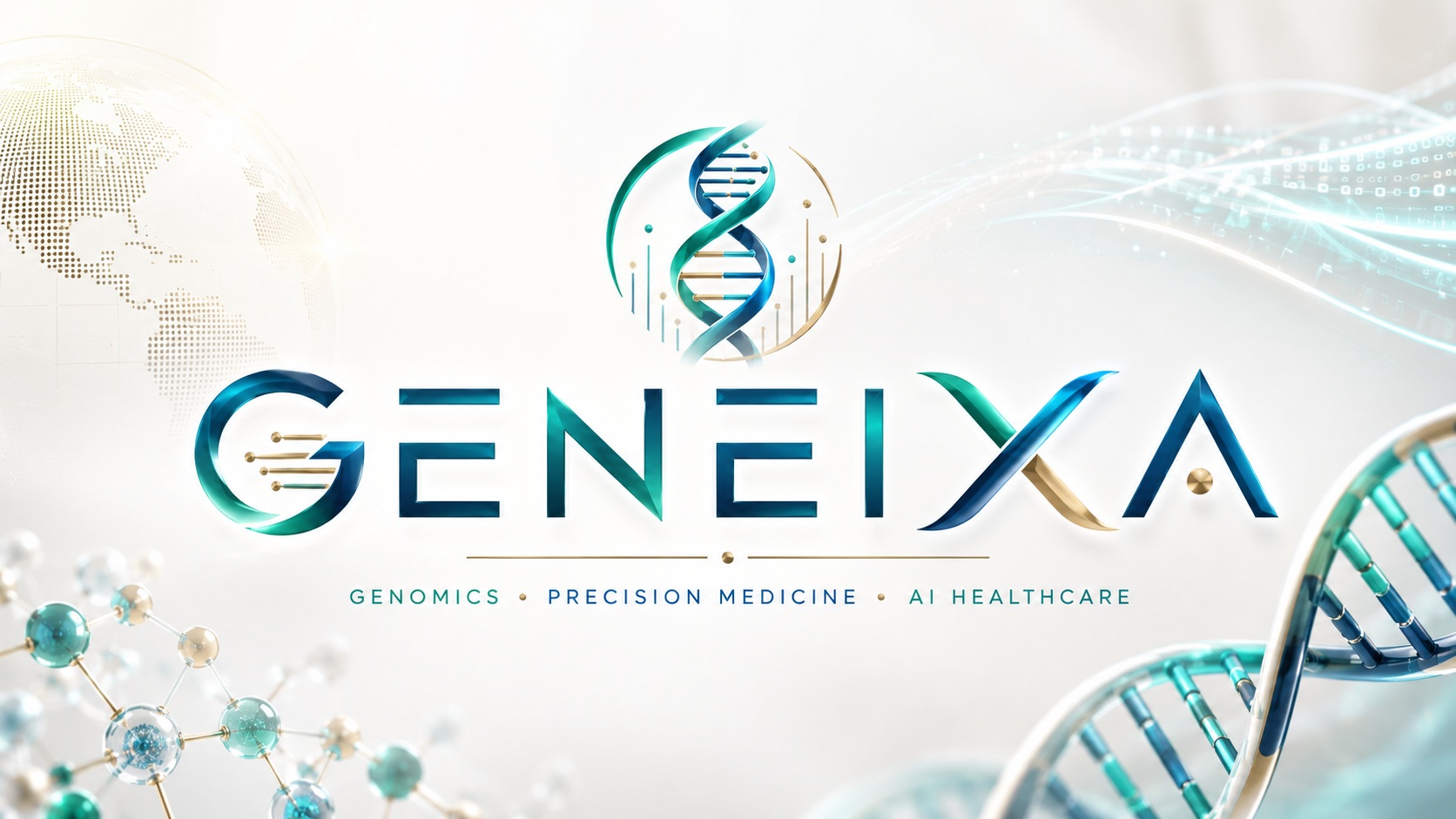
Beyond the Genome Sequence: Why Precision Medicine Needs a Brand That Can Unite Genes, Data and AI
Genomics is moving from a specialist research discipline toward a broader infrastructure layer for diagnostics, precision medicine, drug development, clinical decision support and population-scale health data. That transition creates a naming problem for founders: a company may begin with one genetic test or bioinformatics workflow, then expand into software, analytics, clinical partnerships, AI-assisted interpretation or therapeutic development. GENEIXA.com provides a useful Deep Identity Case Study because its name signals the biological territory immediately while leaving enough proprietary space for the company behind it to evolve.
The strongest genomics brand should be specific enough to signal science and broad enough to survive the next scientific platform shift
GENEIXA begins with the most useful semantic anchor in its target field: GENE. It immediately connects the identity with genetics, genomics and biotechnology. The invented IXA ending gives the name a proprietary technology character instead of forcing it into a literal descriptor such as “genetic testing,” “DNA lab” or “gene therapy.”
That combination creates a strategic middle ground: scientific recognition without product lock-in. It can plausibly support a focused genomics company today and a broader precision-health, bioinformatics or AI-healthcare platform tomorrow.
The Market Shift: Genomics Is Becoming an Operating Layer for Precision Health
Genomics is no longer relevant only to basic sequencing research. The National Human Genome Research Institute describes genomic medicine as the application of genomics to medical science and clinical care, while its current definition of precision medicine emphasizes the use of genomic, environmental and lifestyle information to guide medical decisions.
The commercial implication is important. A modern genomics company may participate in diagnosis, risk assessment, pharmacogenomics, rare-disease interpretation, oncology, clinical data integration, bioinformatics, laboratory infrastructure or software that helps clinicians interpret complex biological information.
Europe is building similar infrastructure at population scale. The European Union’s 1+ Million Genomes initiative is designed to enable secure access to genomic and corresponding clinical data across Europe for research, health policy and personalised healthcare. This means the sector’s future is not simply “more DNA tests.” It is increasingly about systems that connect biological data with clinical meaning.
The next genomics leaders may not be defined by sequencing alone. They may be defined by how effectively they turn biological information into usable decisions.
The Market Problem: Biotech Names Often Describe the First Product Too Literally
Life-science companies face a naming tension that is less visible in ordinary consumer markets. The name has to sound scientifically credible, but it also has to survive long development cycles, changing platforms, regulatory pathways, partnerships and new indications.
A company can begin as a genetic-testing provider and later become a clinical software platform. A bioinformatics startup can expand into precision oncology. A laboratory technology company can add AI interpretation. A research tool can become infrastructure used by hospitals, pharmaceutical companies or population-health programs.
If the parent name is attached too tightly to one workflow, the company can accumulate brand debt precisely when its scientific capabilities are expanding.
Test Lock-In
A name centered on one genetic test can become too narrow when the business adds software, data or clinical services.
Technology Lock-In
A brand tied to one sequencing method, algorithm or platform may age faster than the company’s science.
Indication Lock-In
A disease-specific identity can become restrictive when the underlying technology applies across multiple clinical areas.
Research Lock-In
A name that sounds like a temporary academic project may struggle to support commercial, clinical or enterprise-scale positioning.
The Naming Vacuum: Scientific Authority Without Clinical Coldness
Biotechnology names often fall into two extremes. Some are highly descriptive and technical, which can create immediate scientific recognition but weak differentiation. Others are completely invented, which can become distinctive but require extensive explanation before investors, clinicians or partners understand the field.
GENEIXA occupies the space between those extremes. The opening element provides category recognition, while the proprietary ending gives the company room to build its own meaning.
A biotech identity should communicate enough science to earn relevance, but not so much product description that the company becomes trapped by its first commercial application.
The Identity Thesis: GENE + IXA
The most useful way to analyze GENEIXA is structurally rather than by forcing an artificial acronym onto every letter.
GENE is explicit. It immediately evokes genes, genetics, genomics, heredity, DNA analysis and biotechnology. The suffix IXA has no need for a literal scientific definition. Its role is brand architecture: it converts a generic scientific root into a more proprietary, technology-oriented identity.
This combination helps the name operate at two levels simultaneously. A first-time viewer can recognize the biological sector, while the company retains enough semantic headroom to define whether GENEIXA ultimately becomes a diagnostics company, data platform, bioinformatics business, precision-medicine system or broader AI-healthcare ecosystem.
GENEIXA communicates the scientific territory before the company has to define the final product.
That is the central naming advantage: genes are visible in the identity, but the future business model remains open.
The Semantic Architecture Test
| Element | Brand Function | Strategic Effect |
|---|---|---|
| GENE | Direct biological and genomic signal | Establishes immediate relevance to genetics, genomics, DNA and life sciences. |
| IXA | Invented proprietary technology ending | Separates the identity from generic scientific descriptors and creates room for brand ownership. |
| GENEIXA | Science + proprietary identity | Can accumulate meaning across diagnostics, software, data and precision-health applications. |
| .COM | Global corporate digital layer | Supports one stable identity across research, investor communication, partnerships and international markets. |
The Phonetic Test: Can a Scientific Brand Be Easy to Say?
Biotech names often become difficult when they combine multiple Greek or Latin roots, chemical references or dense consonant clusters. That may be acceptable for a molecule code but creates friction for a company expected to appear in investor meetings, clinical conferences, podcasts, recruiting, enterprise procurement and international partnerships.
GENEIXA has a relatively smooth spoken structure. A future owner would still need to establish one canonical English pronunciation and use it consistently, but the name does not require specialist scientific knowledge to say or remember.
The most important benefit is cognitive balance: it sounds scientific without sounding like a compound identifier.
Scientific enough for biotechnology, smooth enough for a commercial brand. The future owner should standardize pronunciation early and repeat it consistently across conferences, video, investor communication and clinical partnerships.
The Visual Test: DNA Without the Generic DNA Logo
GENEIXA has strong visual territory, but the obvious solution—another generic DNA helix—would underuse the brand. The identity can instead combine genomic structure with computational precision: helix geometry, molecular networks, sequencing patterns, data grids, cellular architecture and restrained AI circuitry.
A premium visual language can use emerald, teal, sapphire, cyan and controlled champagne-gold accents on a light pearl or clinical-white background. That allows the identity to feel sophisticated and scientific without becoming sterile, dark or overly pharmaceutical.
The letter X inside GENEIXA can also become a useful visual hinge, symbolizing crossing data layers, biological pathways or the intersection between genomics and intelligence.
Brand Character Matrix
| Dimension | GENEIXA Character | Strategic Implication |
|---|---|---|
| Scientific ↔ Consumer | Science-led | Strong natural credibility for genomics, diagnostics and life sciences. |
| Descriptive ↔ Abstract | Semi-descriptive | GENE communicates sector; IXA preserves proprietary brand space. |
| Research ↔ Commercial | Balanced | Can work for scientific platforms without sounding like a temporary research code. |
| Single Product ↔ Platform | Platform-oriented | The name can remain stable across software, diagnostics, analytics and clinical services. |
| Local ↔ Global | Global | The biological root is broadly understandable in international scientific and business environments. |
| Traditional Biotech ↔ AI-era Health | Future-facing | The technology-oriented ending makes the identity compatible with computational biology and AI-healthcare systems. |
Market Fit: Where Could GENEIXA Be Most Credible?
| Potential Category | Fit | Brand Logic |
|---|---|---|
| Genomics Platform | Very High | The gene signal is immediate while the parent identity remains broad enough for multiple genomic workflows. |
| Precision Medicine Company | Very High | The name can sit above diagnostics, clinical data, decision support and personalised-health applications. |
| Bioinformatics / Genomic Data | Very High | The scientific root and modern suffix fit software that interprets biological information. |
| Genetic Testing | High | Direct category relevance without forcing the company to remain only a testing provider. |
| AI Healthcare / Computational Biology | High | The name can bridge biological information and intelligent analysis without embedding one algorithm into the identity. |
| Drug Discovery / Biomarker Platform | High | Strong enough for life-science infrastructure while remaining broader than one therapeutic program. |
| Gene Therapy Company | High | The sector fit is clear, although the future company would require distinct regulatory and clinical credibility beyond branding. |
| Unrelated Consumer Lifestyle | Low | The explicit gene association would create expectations that the company operates in biology or health. |
The Deployment Test: Can GENEIXA Support a Scientific Product Family?
A scalable biotech brand should be tested as an architecture rather than as one homepage title. The following product extensions illustrate how GENEIXA could remain the corporate layer while each product communicates a specific function:
GENEIXA Core
The underlying genomic data, interpretation or analysis engine.
GENEIXA Clinical
Clinical genomics, diagnostic workflows and healthcare integration.
GENEIXA Atlas
Population-scale genomic data, cohort exploration or variant intelligence.
GENEIXA AI
Machine-assisted interpretation, multimodal analysis or research decision support.
GENEIXA Labs
Research, validation, assay development or translational-science programs.
GENEIXA One
A unified clinician, patient or partner interface across the broader ecosystem.
These are illustrative naming exercises, not existing GENEIXA products. Their purpose is to test whether the parent identity can support expansion. The structure is strong because each extension explains the function while GENEIXA remains recognizable across the system.
The AI + Genomics Test: Can the Name Survive Computational Biology?
One of the most important long-term questions for a genomics brand is whether it remains credible when the company becomes increasingly computational. Genomic datasets are large, complex and often interpreted alongside clinical, phenotypic, imaging or environmental information. This creates natural demand for informatics and increasingly sophisticated analytical systems.
GENEIXA is well positioned for this convergence because it does not end in “lab,” “test” or another physical-workflow descriptor. The brand can move from laboratory science toward software and AI-assisted interpretation without losing its biological identity.
This makes it a useful complement to the DOMEIXA analysis of AIXOLO.com and global AI startup branding. AIXOLO begins from AI and expands outward; GENEIXA begins from biology and can absorb intelligence as the analytical layer above genomic data.
GENEIXA does not need to choose between “gene company” and “AI company.” Its strongest strategic territory is the intersection where biological data becomes computational intelligence.
The Clinical Trust Test: Biotech Branding Has a Higher Burden
A strong name can establish relevance, but healthcare and biotechnology demand more than relevance. Clinical claims, diagnostic use, therapeutic development, laboratory quality, data governance and patient privacy all require substantive scientific and regulatory systems.
The FDA maintains an expanding list of approved cellular and gene therapy products and continues to publish guidance for the field. That demonstrates both the maturity and the regulatory complexity of advanced genetic medicine. A future company using GENEIXA in clinical or therapeutic contexts would therefore need evidence, quality systems, appropriate approvals and responsible communication behind the identity.
The same principle applies to genomic data. The larger the dataset and the closer the company moves toward clinical care, the more important consent, privacy, security, interoperability and data governance become.
In genomics, branding can communicate scientific ambition. Only evidence, governance, privacy, quality systems and regulatory execution can convert that ambition into clinical trust.
The Founder Perspective: Name the Platform, Not Only the Assay
A founder may begin with one clear offering: a hereditary-cancer panel, rare-disease interpretation service, pharmacogenomics workflow, genomic-data pipeline or AI model for variant analysis.
Product focus is essential. Naming optionality is different. If the first product succeeds, the company may discover that its strongest commercial opportunity lies one layer above or below the original offering—data infrastructure, interpretation, clinician software, population genomics, therapeutic partnerships or enterprise integration.
GENEIXA gives the founder room to make those transitions without changing the parent identity. This is the same structural idea explored in FIRABA.com and cross-border corporate naming: the company can evolve while the parent brand remains stable.
The Investor Perspective: Platform Optionality Without Scientific Vagueness
Investors do not fund biotech companies because the domain sounds scientific. They evaluate the team, science, intellectual property, regulatory strategy, data, commercial model, partnerships and capital requirements. But naming can still reduce unnecessary friction.
GENEIXA has a useful investor-facing balance: the sector is visible immediately, yet the company is not locked into one therapy, one assay or one computational method. That can be strategically helpful in a field where successful companies often broaden their platforms after initial validation.
This is different from the symbolic compression explored in 79ON.com, where the identity is built around gold’s atomic number and digital activation. GENEIXA is more explicit: the category signal itself is part of the word.
The Product-Market Expansion Test
| Strategic Change | Identity Survival | Assessment |
|---|---|---|
| Genetic test → genomic platform | Strong | The name signals genes without containing a testing-specific descriptor. |
| Laboratory workflow → clinical software | Strong | GENEIXA can move from physical laboratory activity toward digital interpretation. |
| Bioinformatics → AI-assisted precision medicine | Strong | The proprietary ending leaves room for computational positioning. |
| Single disease → multi-disease platform | Strong | No disease-specific word needs to be removed from the parent identity. |
| Research tool → healthcare ecosystem | Strong | The brand has enough commercial character to move beyond academic research. |
| Genomics → unrelated non-biological category | Weak | The explicit GENE signal intentionally anchors the company to biology and life sciences. |
The .COM Layer: Institutional Continuity in a Trust-Sensitive Sector
A .COM does not create scientific credibility, regulatory approval or search rankings by itself. Its practical value is continuity. The same corporate identity can appear across investor relations, scientific publications, clinical partnerships, software dashboards, laboratory portals, recruiting, conference materials and future product divisions.
For biotechnology, this consistency matters because the company may need to communicate simultaneously with researchers, clinicians, regulators, pharmaceutical partners, investors and patients. A stable parent identity reduces the need to rebuild recognition every time the company expands into a new application.
The broader DOMEIXA BioTech & Gene portfolio applies this principle across genomics, gene engineering, bioinformatics and future healthcare identities.
International Scalability: Genomics Is Global, Healthcare Is Local
Genomics has inherently international scientific relevance, but clinical deployment is shaped by local regulation, privacy rules, reimbursement, healthcare systems and population data. A strong global brand therefore needs to travel even when the product strategy must be localized.
| Market | Strategic Context | GENEIXA Consideration |
|---|---|---|
| United States | Genomics, precision medicine, gene therapy, diagnostics, biotech venture capital | The gene signal is immediately understandable in a major global life-science market. |
| Canada | Genomic research, precision health and North American biotechnology | The English-compatible structure transfers naturally while preserving a global .COM identity. |
| United Kingdom | Genomics, clinical research, biotech finance and precision medicine | The name works across research and commercial environments without depending on a U.S.-specific phrase. |
| Netherlands | European life sciences, health technology and international research collaboration | The compact invented suffix helps the brand remain international rather than country-specific. |
| Estonia | Digital health, health data and cross-border technology | The combination of genomics and digital identity fits a market known for digital infrastructure. |
| Germany | Biotechnology, diagnostics, pharmaceutical R&D and clinical technology | The explicit scientific root supports serious B2B and research positioning. |
| Switzerland | Pharma, biotech, precision medicine and high-trust healthcare | The brand can support a premium scientific presentation suited to partnerships and enterprise environments. |
| Singapore | Asia-Pacific biotech, healthcare innovation and genomic research | The English-neutral scientific structure is compatible with an international technology and research hub. |
The strategic principle is the same as in other globally scalable DOMEIXA identities: the brand can remain global while regulation, clinical evidence and product delivery remain local.
The Counter-Thesis: Where GENEIXA Has Real Limits
The gene signal is powerful but restrictive: GENEIXA is naturally strongest in genomics, genetics, biotech and precision health. It is not a neutral name for unrelated industries.
The name does not establish scientific validity: laboratory performance, clinical evidence and regulatory status must stand independently of branding.
Healthcare language requires discipline: marketing should never imply diagnosis, treatment, prevention or clinical performance beyond what the actual product is authorized and evidenced to provide.
Privacy and genomic-data governance matter: a genomics company may handle unusually sensitive biological information and must design security, consent and governance accordingly.
Trademark clearance remains separate: ownership of GENEIXA.com does not establish trademark availability in any jurisdiction or commercial class.
GENEIXA vs. AIXOLO, FIRABA, 79ON and DOZIPO: Different Identity Architectures
DOMEIXA’s case-study library is strongest when every identity solves a different naming problem. AIXOLO starts from AI and builds a global technology brand around it. FIRABA is a category-neutral corporate empty vessel. 79ON compresses a scientific symbol for gold into a digital-wealth identity. DOZIPO is consumer-led and designed for multi-service platform expansion. GENEIXA is different again: it combines immediate scientific category recognition with proprietary life-science brand space.
| Identity | Core Naming Logic | Strongest Environment |
|---|---|---|
| GENEIXA | Genomics signal + proprietary biotech identity | Genomics, precision medicine, bioinformatics, AI healthcare, life sciences |
| AIXOLO | AI signal + invented technology core | AI startups, agentic platforms and software ecosystems |
| FIRABA | Abstract global corporate identity | Holdings, investment, consulting, fintech and international business |
| 79ON | Scientific symbol + activation | Gold, digital wealth and precious-metals infrastructure |
| DOZIPO | Friendly abstract consumer identity | Local commerce, mobility, marketplaces and multi-service apps |
Strategic Verdict
Genomics platforms, precision medicine, bioinformatics, genetic testing, AI healthcare and life-science technology.
Scientific, modern, proprietary, international and platform-oriented.
Immediate genomics recognition without locking the company to one assay, disease or product format.
The explicit gene association intentionally narrows the identity to biology, biotechnology and healthcare.
Strong structural portability across major biotech and precision-health markets.
High inside the broader genomics, data, diagnostics and computational-biology ecosystem.
The Larger Lesson: The Genome Is Not the Product—It Is the Information Layer
The most important strategic shift in genomics may be conceptual. Sequencing produces biological information, but the commercial value of a genomics company can emerge from what happens next: interpretation, clinical action, software, research, drug discovery, risk stratification or population-scale insight.
That means a future genomics leader may begin as a laboratory company and end as a data company—or begin as a software company and become an essential clinical infrastructure provider.
GENEIXA is compelling as a naming case study because its identity begins at the correct conceptual level. It signals the biological foundation without dictating the final commercial layer built above it.
GENEIXA does not have to mean one genetic product. It can become the name of the system that connects genes with intelligence, precision and future healthcare.
Explore the dedicated GENEIXA.com identity profile
This Insights article examines GENEIXA from the perspective of genomics, precision medicine, computational biology and long-term biotechnology brand architecture. The dedicated DOMEIXA profile contains the separate official information relating to the digital asset itself.
Continue the DOMEIXA Identity Research
Sources & Further Reading
National Human Genome Research Institute — Genomic Medicine: NHGRI describes genomic medicine as the application of genomics to medical science and clinical care. NHGRI
NHGRI — Precision Medicine: current definition describing the use of genomic, environmental and lifestyle information to guide medical management. NHGRI
FDA — Approved Cellular and Gene Therapy Products: current list of licensed cellular and gene therapy products maintained by the FDA Office of Therapeutic Products. U.S. Food and Drug Administration
European Commission — 1+ Million Genomes: European initiative designed to enable secure access to genomic and corresponding clinical data for research, health policy and personalised healthcare. European Commission
European Genomic Data Infrastructure: federated infrastructure supporting secure access to genomic, phenotypic and clinical data across Europe. Genomic Data Infrastructure